Proposal sets a 1% emissions reduction target for the natural gas market for 2027 and signals 3%, 4%, and 5% through 2030. About 68% of national biomethane capacity comes from municipal solid waste.
The Ministry of Mines and Energy (MME) opened Public Consultation No. 234/2026 on the annual greenhouse gas (GHG) emissions reduction target in the natural gas market. The obligation is met with biomethane, a fuel that in Brazil originates almost entirely from waste. Landfill operators, waste management concessionaires, public consortia, and municipalities therefore have a direct interest in the outcome. The Public Consultation Portal shows that contributions will be accepted until November 6, 2026.
What is under consultation
MME Ordinance No. 942 of October 2, 2026, published in an extra edition of the Federal Official Gazette on October 5, submits the draft Resolution of the National Energy Policy Council (CNPE) to public participation. The text sets the mandatory target for 2027 and establishes indicative targets for the following three years.
The legal basis is Article 17 of Law No. 14,993/2024 (the Fuel of the Future Law), regulated by Decree No. 12,614/2025. The law adopts 1% as a reference benchmark, allows a lower percentage on an exceptional basis, and caps the target at 10%. For 2026, CNPE Resolution No. 4/2026 set 0.5%; the proposal reinstates the 1% benchmark.
The obligation falls on natural gas producers and importers. Compliance is achieved through the acquisition or use of biomethane or through the registration of Biomethane Certificates of Origin Guarantee (CGOB), each equivalent to 100 m³ of fuel.
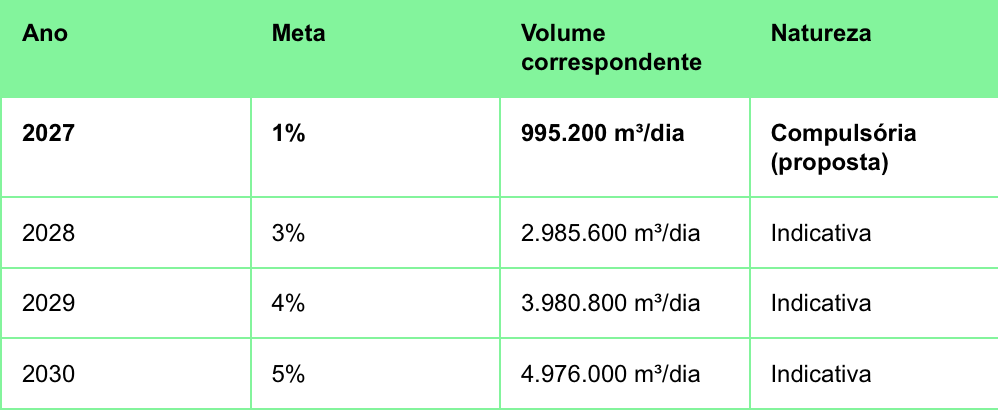
The targets for 2028 to 2030 are non-binding. Each must be confirmed or revised by the CNPE during its respective annual cycle, following a new Regulatory Impact Assessment (RIA).
The numbers supporting the proposal
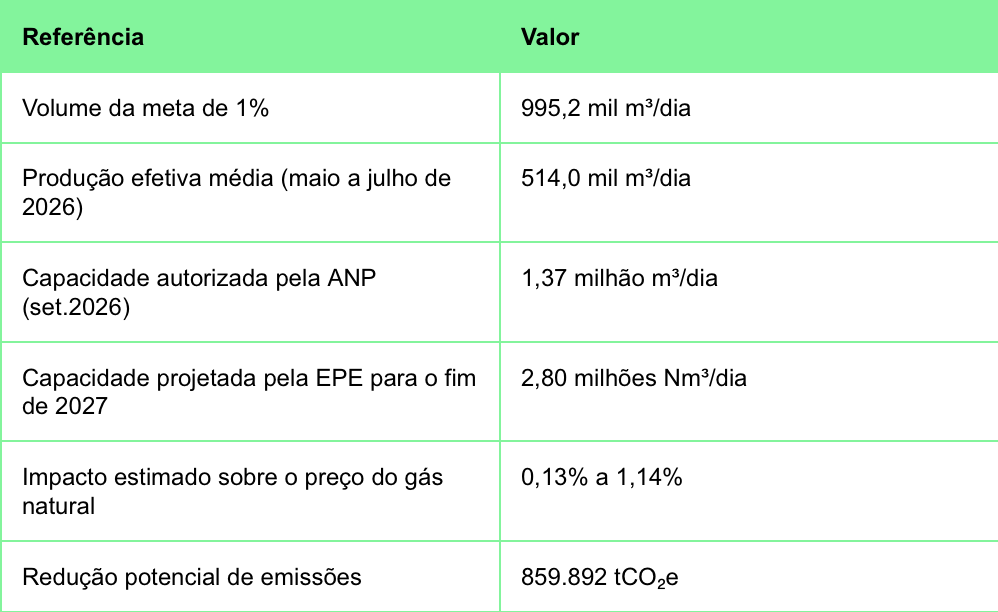
The 1% target is equivalent to 363,249,200 m³ of biomethane in 2027, or 3,632,492 CGOBs. Meeting it requires almost doubling recent production, although the volume fits within the capacity already authorized by the ANP.
The RIA compared six alternatives, ranging from 0% to more than 1%, across a matrix of nine risks derived from Article 5 of Decree No. 12,614/2025. The 1% target achieved the lowest aggregate risk score (70 points), compared to 74 points for 0.75%, 75 for 0.50%, and 132 for percentages above 1%.
The draft also sets the carbon intensities used to convert the target into volume: 76.85 gCO₂eq/MJ for compressed natural gas (CNG), 73.52 gCO₂eq/MJ for stationary combustion natural gas, and 9.36 gCO₂eq/MJ for biomethane. The biomethane value corresponds to the average of the ten plants certified under RenovaBio.
Why this is a waste issue
Brazilian biomethane supply is, at its source, a waste management activity. Of the 21 plants authorized by the ANP as of September 14, 2026, 11 process municipal solid waste (MSW)—mostly landfill biogas—and account for 68.4% of authorized capacity. The remainder operate with sugar-energy and agrosilvopastoral waste and by-products.
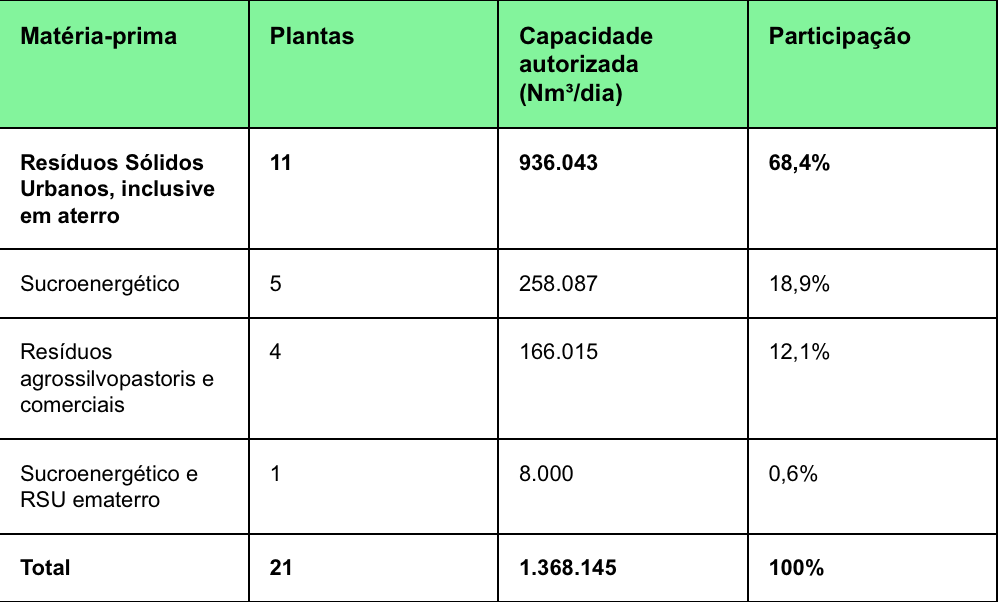
Prepared by S2F based on Table 6 of Clarification Note NE-EPE-DPG-2026-62, with data from the ANP.
The mandatory target converts this activity into regulated demand. Producers now have two sources of value: selling the physical molecule and selling the environmental attribute, represented by the CGOB. For landfills, biogas ceases to be merely a liability to manage and is consolidated as an energy asset.
This movement converges with the National Solid Waste Policy, which includes energy recovery among environmentally sound final disposal methods (Article 3, VII, of Law No. 12,305/2010). It also aligns with the climate agenda, as capturing biogas avoids methane emissions from landfills.
The effect tends to extend to public contracts. In concessions and public-private partnerships for MSW management, revenue from biomethane and CGOBs can be incorporated into financial modeling as ancillary revenue, impacting tariffs, public remuneration, and the risk allocation matrix.
Expansion is already underway. The ANP reports 41 projects in the authorization process, totaling 1,430,402 Nm³/day in additional capacity. The list includes projects from landfill operators and waste management groups across several states.
Key considerations for the waste sector
The RIA itself recognizes information gaps and risks that directly affect those producing biogas and biomethane from waste. Five of these warrant close monitoring and can guide contributions to the consultation.
Eligibility for CGOB. The RIA estimates that only 28% of recent production will be linked, by the end of 2026, to producers eligible to issue the certificate, equivalent to 143,924 m³/day. Origin certification, governed by ANP Resolution No. 996/2026, is a requirement to capture the value of the environmental attribute.
CBIO, CGOB, and the voluntary market. The environmental attribute of a single molecule can only back one certificate. Ten of the 21 authorized plants are already certified under RenovaBio, which necessitates a commercial choice between CBIO and CGOB. Consolidated data on voluntary contracts and the voluntary retirement of certificates are still lacking.
Biogas in electricity generation. Article 4, § 3 of Decree No. 12,614/2025 allows for reducing the target applicable to natural gas used in stationary generation in proportion to the decarbonization achieved with biogas in electricity generation. This deduction was not incorporated into the methodology, and the corresponding indicator remains pending. This is relevant to landfills that generate electricity from biogas.
Infrastructure and logistics. The lack of off-take and transport infrastructure received the highest risk score under the 1% alternative (15 points, high level). Landfills far from the pipeline network rely on road transport, with impacts on costs and the carbon intensity of the product.
Trajectory from 2028 to 2030. The indicative target of 3% for 2028 corresponds to 2.99 million m³/day and exceeds the 2.80 million Nm³/day capacity projected for the end of 2027. This signal fosters new investments, but it is non-binding, which suggests caution in long-term contracts and feasibility studies.
How to participate Contributions must be submitted via the MME Public Consultation Portal, under Public Consultation No. 234/2026, overseen by the Department of Biofuels. The Ordinance also indicates the Participa + Brasil Portal.
The Portal lists the period as October 6 to November 6, 2026. MME Ordinance No. 942/2026, however, establishes a 30-day deadline from its publication date on October 5. As a precaution, submission by November 4, 2026, is recommended.
S2F Partners is monitoring the consultation and is available to assist in assessing impacts and preparing contributions.
Authors: Carlos Silva Filho (carlos@s2fp.com.br) and Fabricio Soler (fabriciosoler@s2fp.com.br)